Gameplay
How to play Kinetic Lotus
Five rules, none of them hidden. Here is the whole game — the ripple, the three plant stages, the chain reaction and the star targets — in the order you meet them.
Kinetic Lotus has five rules and no hidden ones. This page states all of them, in the order you meet them, so you can go from never having played to reading a board properly in a couple of minutes.
The five steps
01
Tap open water to drop a catalyst
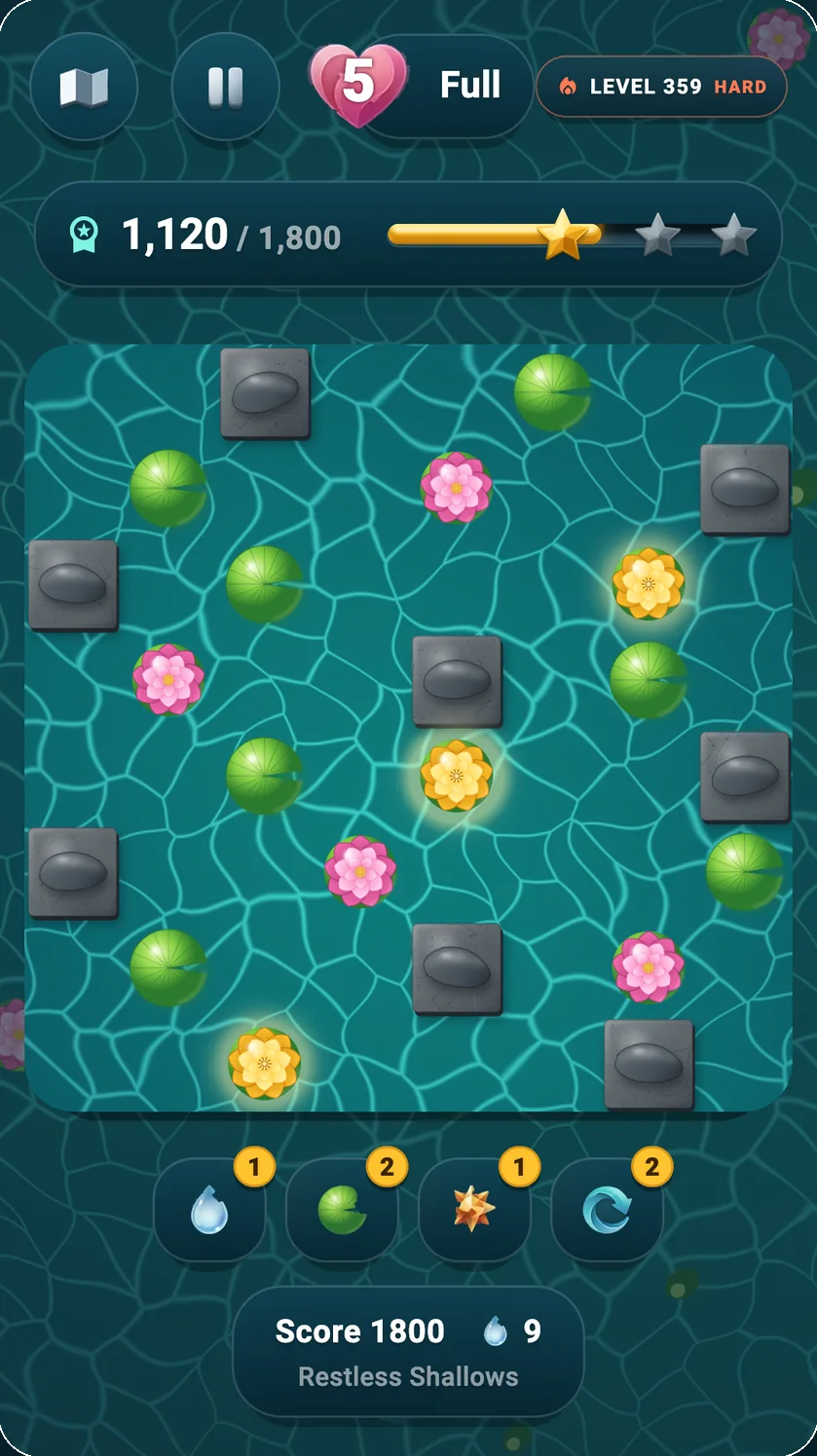
Choose any empty water tile and tap it once. That is the entire control scheme — no dragging, no swiping, no gestures to memorise. The tap places a catalyst, and everything after it resolves on its own.
02
Watch the ripple expand one ring at a time
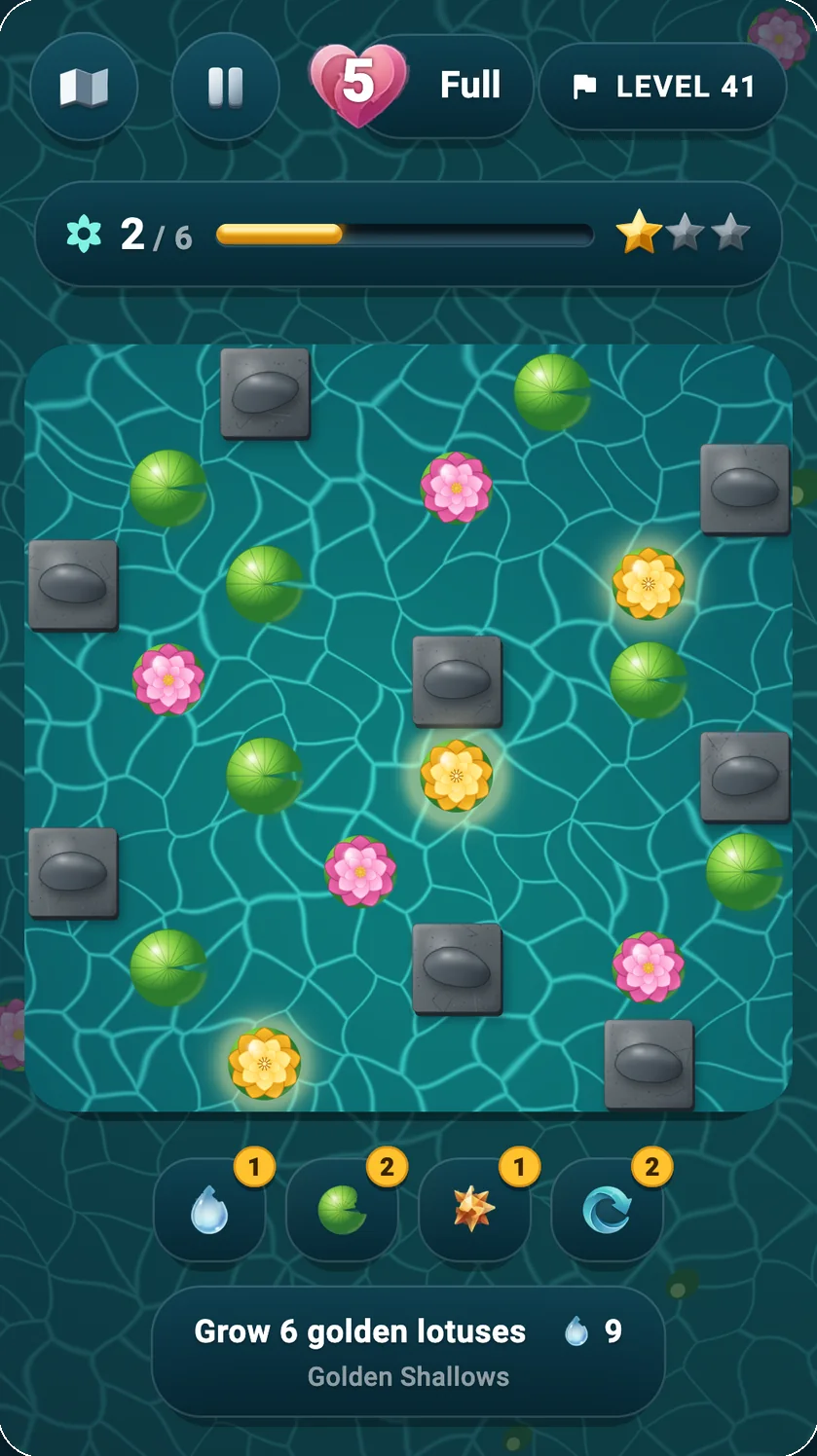
A wave travels outward from your catalyst, resolving each ring of tiles completely before moving to the next. Anything it touches advances one stage: a lilypad becomes a pink lotus, and a pink lotus becomes a golden one.
03
Trigger a golden lotus to start a chain
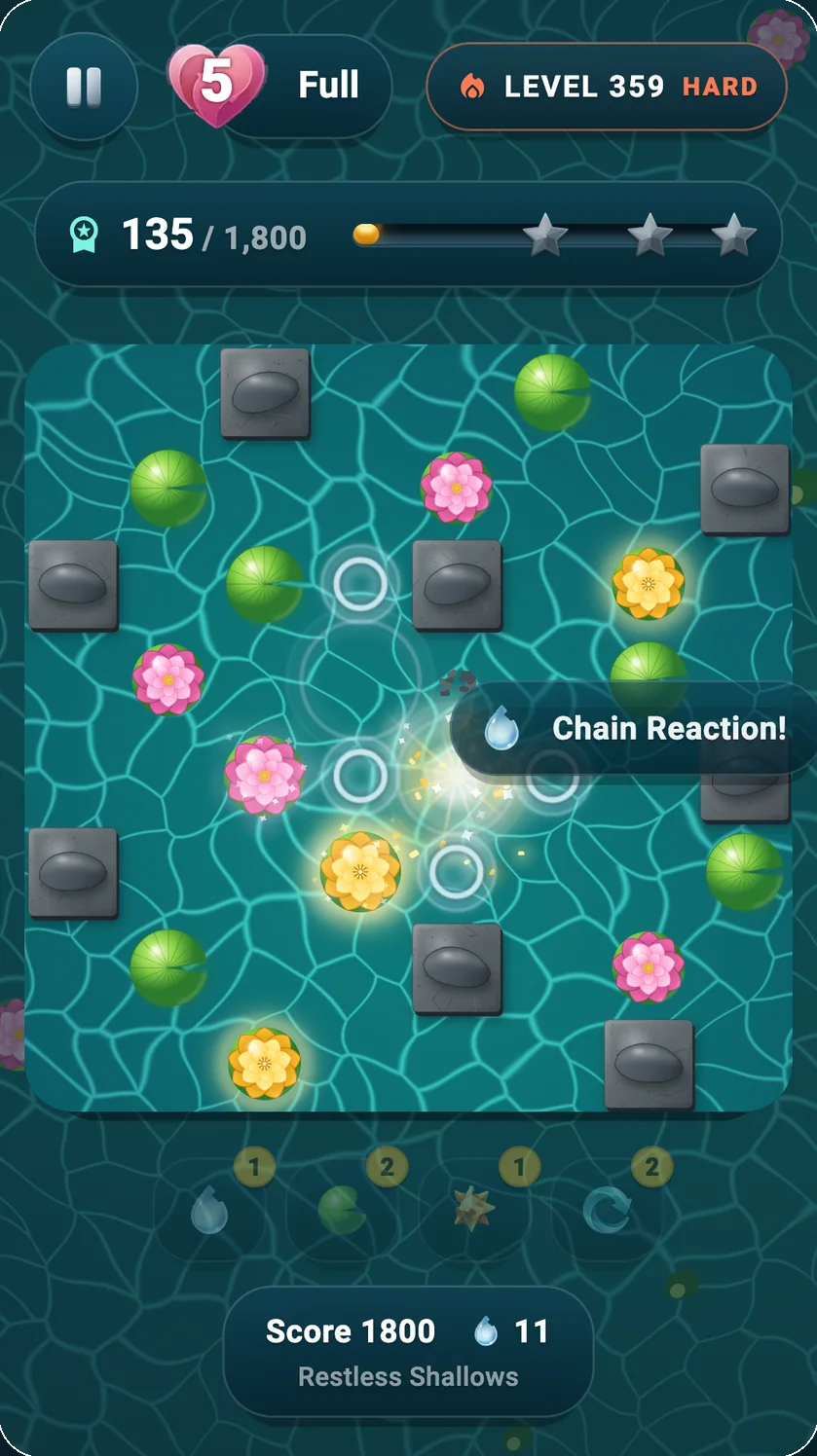
When a ripple reaches a golden lotus, it detonates and throws four fresh ripples outward from its own tile. Each of those can reach another golden lotus, so a single well-placed tap can cascade across most of the board.
04
Use stones to steer the wave
A stone absorbs a ripple, shifts one tile directly away from the wave's origin, and stops it there. Because the direction depends on where you tapped, stones can be shoved into position to shorten a gap or to block a direction that would waste your wave.
05
Hit the star target to clear the level
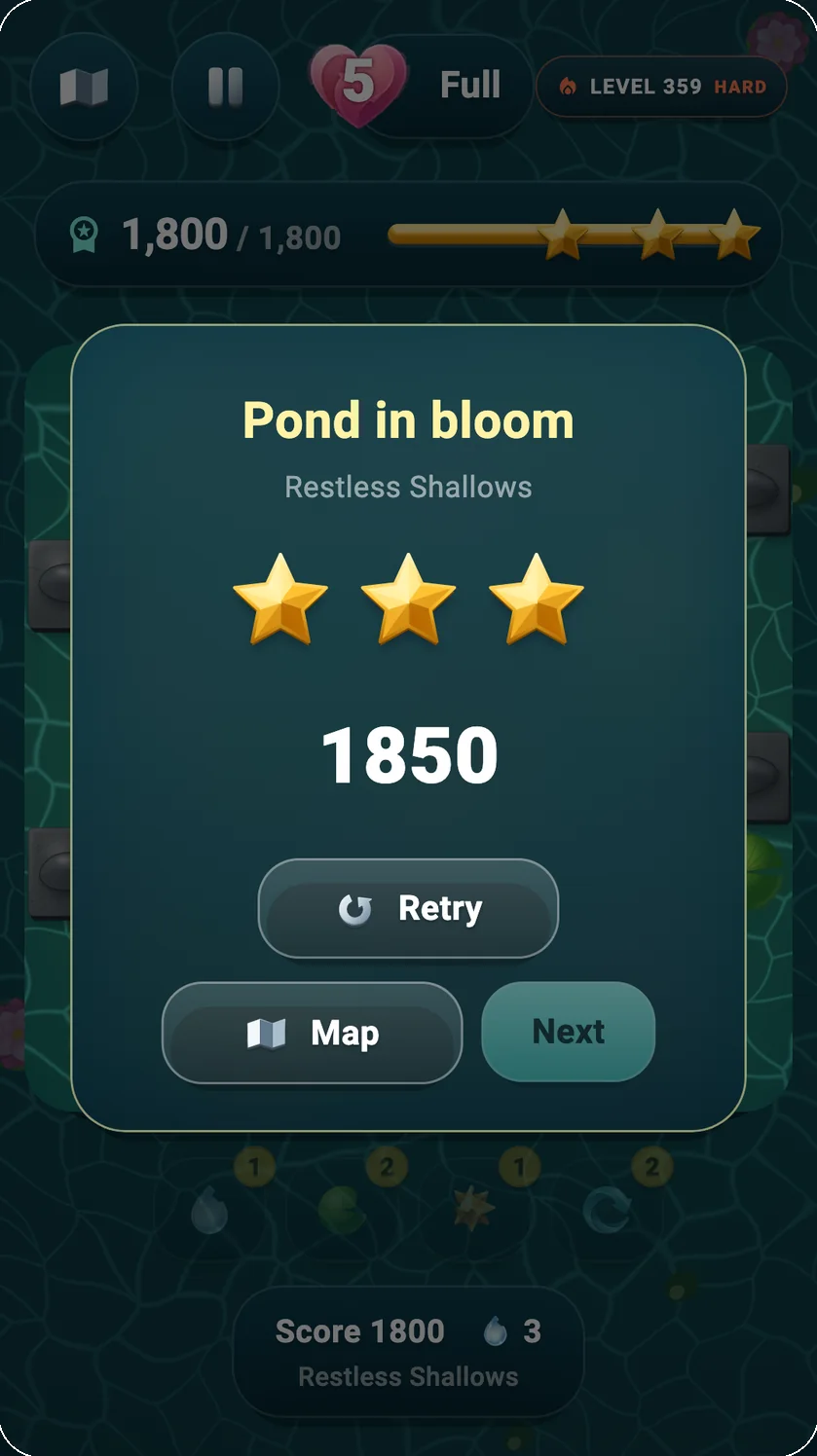
Each level has three score thresholds. Clearing the board earns one star, an efficient clear earns two, and hitting the top target — almost always with a single long chain — earns all three. There is no timer, so you can take as long as you like deciding.
The scoring, in detail
Points come from plants advanced, not from tiles touched. A ripple crossing five empty water tiles scores nothing; a ripple that converts four pink lotuses to gold and detonates two of them scores heavily. This is why efficient play looks so different from thorough play — the goal is never to cover the board, only to convert it.
- One star — clear the board. Reachable by persistence alone; the campaign map only requires this.
- Two stars — clear it reasonably efficiently, usually in two or three taps with one small chain.
- Three stars — hit the top target. On a campaign level, this almost always means finding the single opening tap that starts the longest chain.
Campaign boards are hand-tuned so that exactly one opening reaches the three-star target. If you are consistently landing just under it, you have not found a slightly better version of your idea — you have not found the idea yet. The tips and strategy page covers how to hunt for it.
Lives, perks and the daily puzzle
A failed attempt costs one life, and lives refill on a timer while you are away. You can choose to watch a rewarded ad for an extra one instead of waiting, but nothing in the campaign is gated behind that choice — waiting always works, and no board is unreachable without ads.
Perks sit in a tray at the bottom of the board and are most valuable when you can already see the chain and are one tile short of reaching it. Spending them speculatively on a first attempt is the commonest way players waste them.
Alongside the campaign there is one daily puzzle, identical for every player and generated from the date on your own device rather than downloaded. It works offline like the rest of the game — the post on how the daily works explains why that is possible.
What the game never does
- There is no countdown on any level, and no way to lose a board by being slow.
- There is no fail state in the sense of a game-over screen. A level you do not clear simply resets.
- There are no in-app purchases. Nothing in the campaign can be bought, only played.
- Ads never appear during a puzzle — only between levels, or when you actively choose a rewarded one.
If you want the reasoning behind those four, Designing a Puzzle Game Without Timers covers what removing the countdown cost and what it bought.
Accessibility while you play
The in-game settings include a reduced-motion option that calms the ripple and particle effects, and colourblind-safe palettes so lilypad, pink lotus and golden lotus stay distinguishable without relying on hue. Music and sound effects have separate volume controls, and the single-tap control scheme means the game is comfortable one-handed on any phone size.