Chain Reactions, Explained Tile by Tile
A ripple that reaches a golden lotus throws four new ripples. Understanding the order those resolve in is the difference between a two-star clear and a three-star one.
Every board in Kinetic Lotus is really one question: where does the chain start? Everything else follows from the answer. This post is the mechanical detail behind that question — the propagation rules, in order, with nothing hand-waved.
The three plant stages
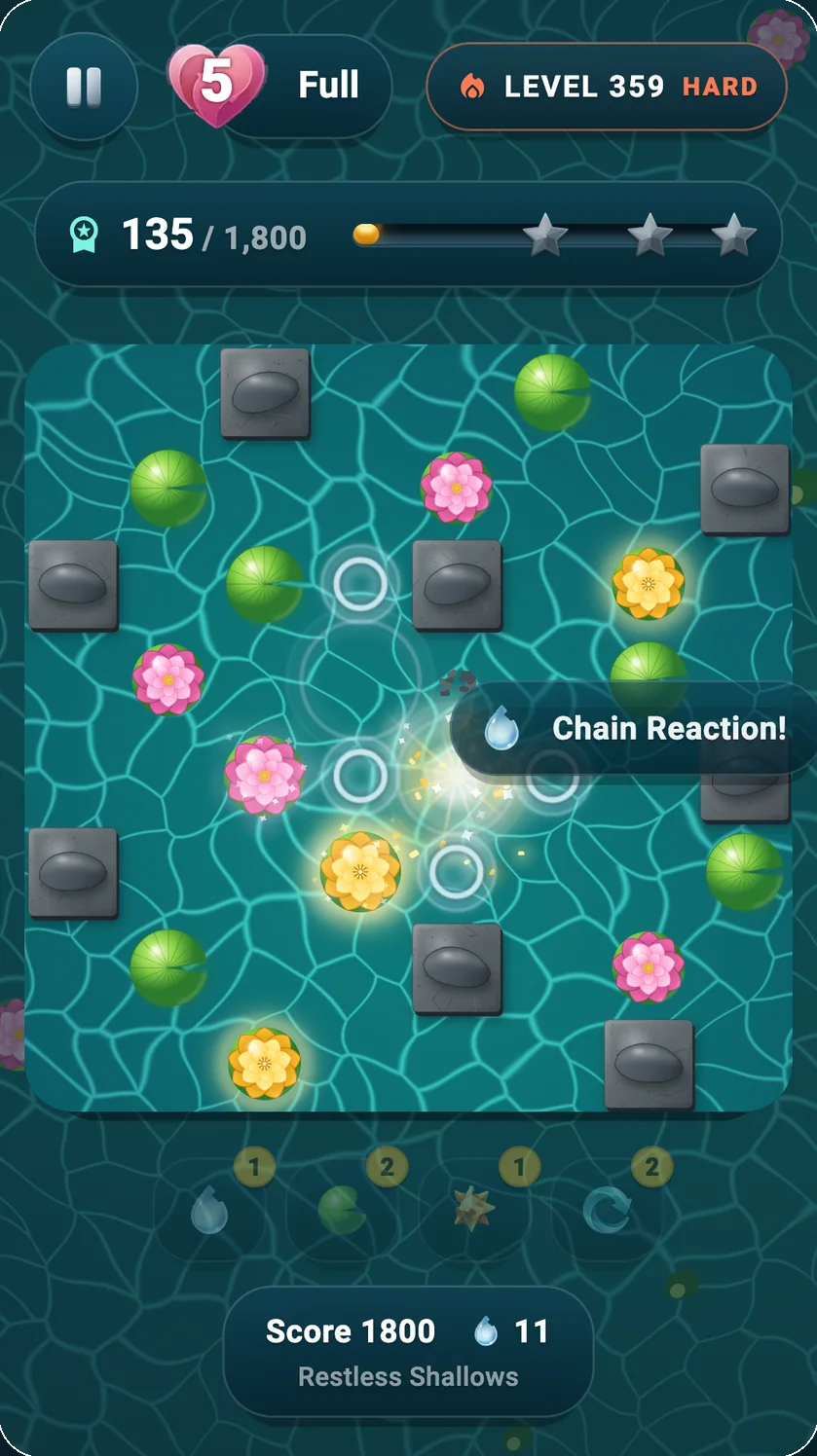
Plants have a fixed progression and never skip a stage. A lilypad struck once becomes a pink lotus. A pink lotus struck once becomes a golden lotus. A golden lotus struck once detonates and is consumed.
This is why board reading is really counting. A tile holding a lilypad needs two separate strikes before it can contribute a detonation; a tile holding a pink lotus needs one. A cluster of pink lotuses is therefore far more valuable than a larger cluster of lilypads, and the whole art of the opening tap is finding the wave that converts the most pink to gold before it runs out of travel.
How a ripple travels
A ripple expands outward from its origin one ring at a time. It resolves each ring completely before moving to the next, which matters more than it sounds: two golden lotuses in the same ring both detonate, and their detonations are queued together rather than resolving one at a time.
- The tap places a catalyst on the chosen open-water tile.
- The first ring of neighbouring tiles resolves: plants advance one stage, stones take a shove.
- Any golden lotus in that ring detonates, adding four new ripples to the queue.
- The original ripple advances to the next ring, and the queued detonations begin their own first rings.
- The process repeats until no ripple has anywhere left to travel.
The practical consequence is that a chain does not simply run further — it runs wider. Each detonation is a new origin, so the board fills from several points at once. A chain with three detonations in it typically touches three or four times as many tiles as the same wave with none.
What stops a wave
Three things end a ripple, and knowing which one you are hitting tells you what to change.
- The board edge. Nothing to be done about this one except start further in.
- A stone. The wave shoves it one tile and stops there. The stone survives; the wave does not.
- Distance. Ripples have a finite reach, so a chain that has to cross a large stretch of empty water will die on the way.
The third is the one players underestimate. Open water looks harmless, but it is where waves go to expire. A board that seems to have a beautiful chain available often has a four-tile gap in the middle of it, and the fix is not a better opening tap — it is a different one, on the other side of the gap.
Setting up a two-detonation chain
The reliable pattern is to find your finishing detonation first and work backwards. Look for the golden lotus, or the pink lotus one strike from gold, that sits closest to the densest part of the board. That is where you want the chain to arrive, not where you want it to start.
Then ask what could reach it. Trace outward from that tile to find another gold-capable plant within one ripple's reach. If you find one, you have your chain: tap so that your opening wave hits the far plant, its detonation carries into the near one, and the near one's four ripples land in the dense cluster you identified at the start.
Beginners tap where the plants are. Experienced players tap where the plants are not, so that the wave arrives at the plants with somewhere to go afterwards.
Using stones on purpose
Because a stone absorbs a wave and shifts a tile, a stone in the wrong place is a wall and a stone in the right place is a redirect — you can shove one into a position that shortens the gap a later ripple has to cross. This is the mechanic that separates the last chapters from the first, and it gets a full treatment on the tips page.
If any of this is new, start with the gameplay guide for the basic rules, then come back. And if you have not played it yet, Kinetic Lotus is free on Google Play.