Designing a Puzzle Game Without Timers
When players cannot lose, difficulty has to move somewhere else. In Kinetic Lotus it moved into the third star — and that changed how every board gets built.
The first playable build of Kinetic Lotus had a timer. Not because anyone wanted one — because removing it broke the game, and adding it back was easier than working out why.
Without the countdown, every board could be brute-forced. Tap, watch, tap again, watch again, and eventually the level clears. The puzzle was still there, but nothing required you to engage with it. You could win by not thinking, slowly.
Where the difficulty went
The fix was to separate two things that most puzzle games fuse together: passing a level, and solving it. In Kinetic Lotus, passing is deliberately easy. Almost every board in the campaign will fall to persistence. The map only asks that you pass.
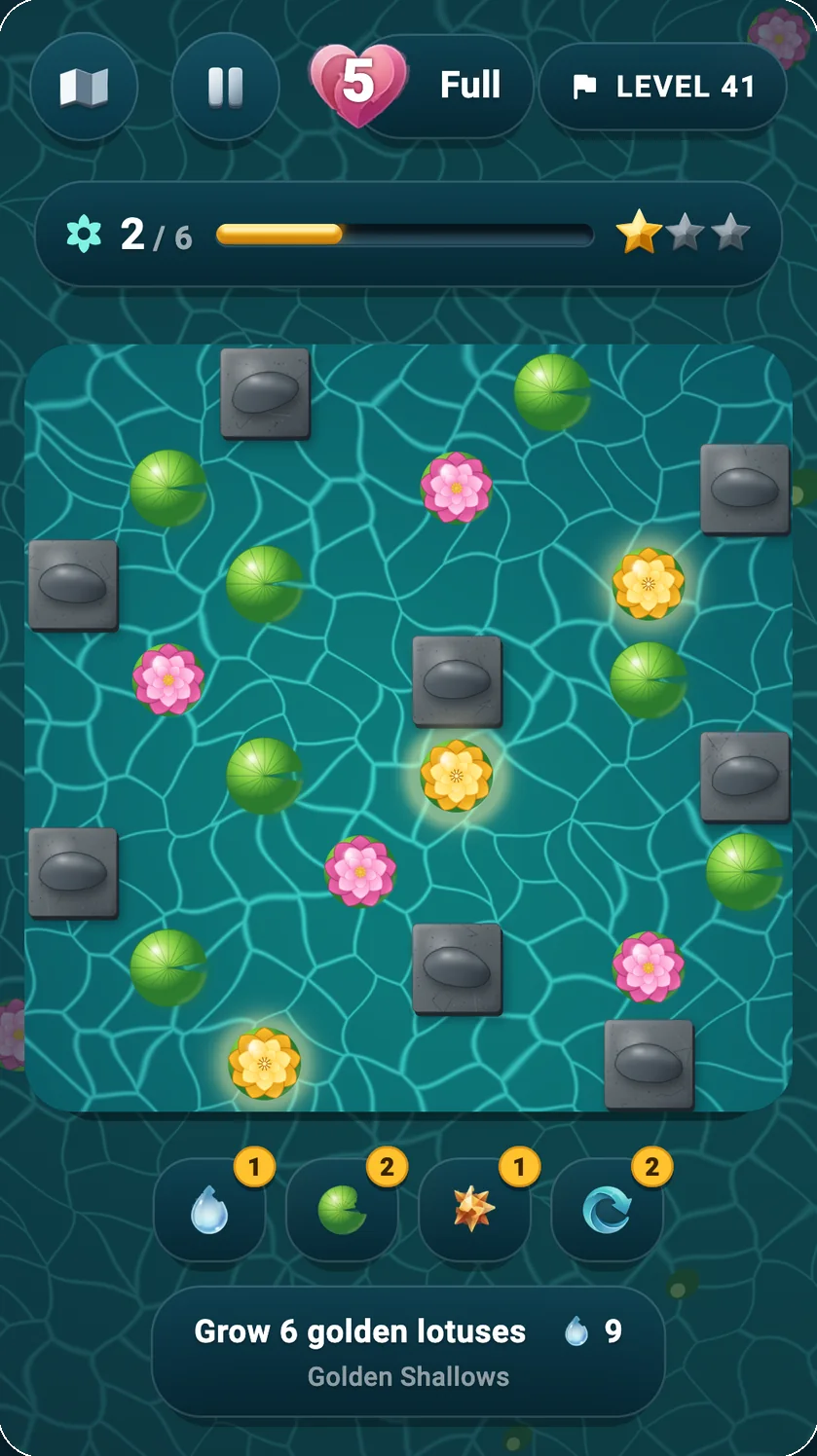
The actual game is the third star. Three stars requires hitting the board's top score target, which in practice means finding the single tap that starts the longest chain reaction. That is a genuinely hard search problem on a well-built board, and — crucially — it is a problem you solve by looking rather than by hurrying.
- One star: clear the board. Available to anyone who keeps tapping.
- Two stars: clear it reasonably efficiently. Available to anyone who thinks a little.
- Three stars: hit the top target. Usually exactly one opening tap does it.
The effect on the feel of the game was immediate. Nobody is stressed at a board they cannot lose. But a lot of people are extremely stubborn about a board they have two-starred, and that stubbornness is entirely self-imposed — you can walk away from it at any moment and the game will not mention it again.
What it did to level design
Building for a star target rather than a timer changed the craft of level design considerably. A timed board is tuned by adjusting seconds. An untimed board has to be tuned by adjusting geometry, which is slower, more interesting, and much less forgiving.
Every board needs exactly one best answer
If two openings both reach the top target, the board is not a puzzle — it is a coin flip that happens to be solvable twice. If none do, the third star is unreachable and the player is being lied to. Getting to exactly one required writing a solver that plays every legal opening tap on a board and reports the score distribution, and then hand-adjusting stone placement until the distribution has a single clear peak.
The second-best answer has to be visible
A board where the optimal tap is obvious is boring. A board where it is invisible is unfair. The sweet spot is a board with an appealing wrong answer — an opening that looks like it should chain, gets you comfortably to two stars, and stops one tile short. Players find that one first almost every time, and the moment where they see why it fails is the moment the board teaches them something.
The cost
This approach is not free. Three things got harder, and it is worth being honest about them.
- Level throughput dropped. A hand-tuned board with a single optimal answer takes far longer to build than a timed one, which is why the campaign grows in chapters rather than continuously.
- Retention signals got weaker. Timers create urgency, and urgency creates sessions. A game that never nags has to be worth opening on its own merits.
- Difficulty is harder to communicate. A player who three-stars everything early has no idea the ceiling is much higher later, because nothing on screen is escalating visibly.
The third one is the reason the tips page exists. Some of what makes late boards hard is not discoverable by playing early boards, and a game with no pressure also has no natural moment to teach.
Would we do it again
Yes, without hesitation. The clearest signal came from players describing the game as something they open instead of scrolling — which only works if the game is never in a hurry. A countdown would have bought us better week-one numbers and cost us the entire reason the thing exists.
If you want to see how the star targets actually work, the gameplay guide walks through the ripple rules, and Kinetic Lotus is free on Google Play.