Physics Puzzles Are Just Logic Puzzles
A physics puzzle with fully deterministic rules is a logic puzzle with better animation. That is the whole trick behind Kinetic Lotus.
App stores sort puzzle games into physics-based and logic-based as though they were opposites. Ask a player which one they prefer and you will usually get an answer about feel rather than mechanics — physics games are the ones where things fall over, logic games are the ones with grids.
Why non-determinism feels different
In a continuous physics simulation, small differences in your input compound. Release a block a pixel to the left and the tower falls the other way. That is genuinely fun — it is the entire appeal of a certain kind of sandbox game — but it means you cannot reason your way to the answer. You can only develop an intuition and then try things.
The moment you cannot reason to the answer, retrying becomes the dominant strategy, and the game's difficulty becomes a function of patience rather than insight. This is why so many physics puzzle games end up with an undo button, a retry counter, and a slightly frustrating late game.
Discretising the simulation
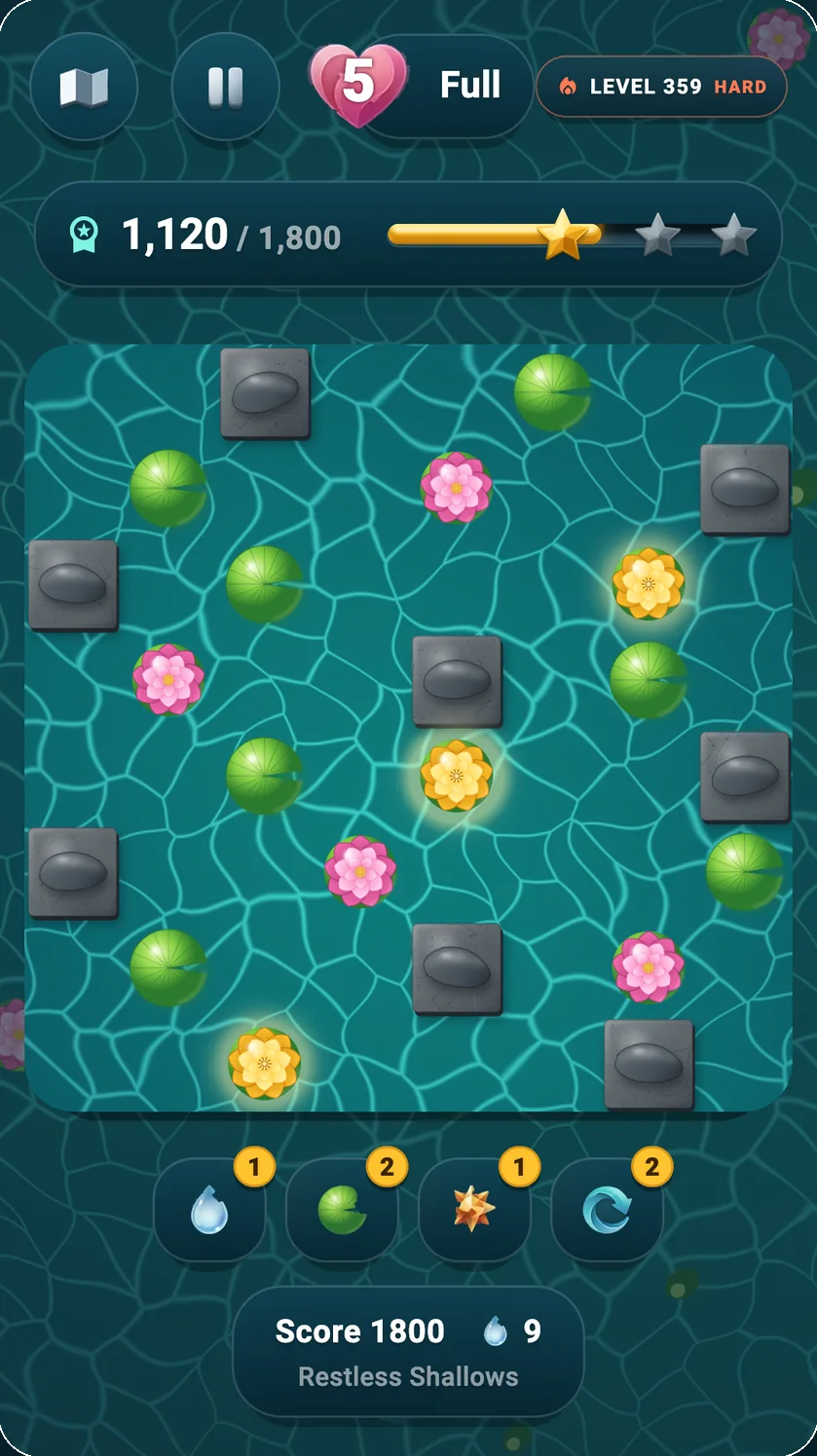
Kinetic Lotus runs what is unmistakably a physics idea — a wave propagating outward through a medium, shoving objects and transforming what it touches — on a grid, in discrete steps, with integer rules. There is no floating-point drift and no simulation noise. A ripple travels one tile per step, and the outcome of an opening tap is fully determined before the animation begins.
That single choice converts the whole game. Because the wave is deterministic, you can trace it in your head. Because you can trace it, planning beats retrying. And because planning beats retrying, the game can afford to have no timer and no punishment — see the post on removing the countdown for what that costs and buys.
What you keep from physics
Discretising the rules does not mean discarding the feeling. The ripple still looks and sounds like water. Stones still have weight to them when a wave shoves them. The chain reaction still has the escalating, slightly out-of-control quality that makes a physics game satisfying to watch.
The difference is that the loss of control is scheduled. You gave up control at the moment you tapped, deliberately, having already worked out roughly what would happen. Watching it play out is a confirmation rather than a gamble — and when it goes further than you predicted, that surprise is the reward for having predicted anything at all.
What you keep from logic puzzles
- A single correct answer per board, which makes a three-star clear a real achievement rather than a lucky one.
- Solvability without trial and error, so the game is playable by someone thinking carefully and slowly.
- Rules that are learnable in full. Every mechanic in Kinetic Lotus is described completely on the gameplay page; nothing is hidden behind feel.
Which genre should you search for
If what you like is the moment a system does something bigger than you expected, search for physics puzzle games. If what you like is being right, search for logic puzzle games. Kinetic Lotus is trying to be both at once, which is only possible because the physics is fake in exactly the right way.
The mechanics deep dive goes through the propagation order tile by tile, and the game is free on Google Play.