What Actually Makes a Puzzle Game Relaxing
A puzzle game is relaxing when it cannot punish you for stopping. Everything else — the palette, the piano, the pond — is decoration on top of that one property.
Search for a relaxing puzzle game and you will get a hundred results that look identical: soft gradients, a woodwind loop, a title in a thin serif. Install five of them and three will have a countdown bar inside two minutes. The visual language of calm has become completely detached from the thing it is supposed to describe.
We spent a long time on this question while building Kinetic Lotus, and the conclusion was structural rather than aesthetic. There are four decisions that determine whether a puzzle game is genuinely restful, and they are all made in the rules, not the render.
1. Nothing may run while you are thinking
The moment a number on screen changes without your input, the game has started making demands. A countdown is the obvious version, but there are quieter ones: a score that decays with elapsed time, a multiplier that resets, an energy bar that fills while you are not looking so that leaving feels like waste.
All of these convert thinking time into a cost. That is a perfectly good design choice for an action game — it is the entire point of an action game — but it means the player can never fully stop and consider. In a relaxing puzzle game, staring at a board for four minutes and then putting the phone down should be indistinguishable, mechanically, from solving it instantly.
2. Failure has to be cheap and quiet
Most puzzle games understand that failure should be recoverable. Fewer understand that it should be undramatic. A red flash, a descending sting, a shattering animation and a modal asking whether you would like to continue — that is four separate signals telling you that something bad happened, in a game where the stakes are a rearrangement of tiles.
In Kinetic Lotus a level you do not clear simply ends, and the pond resets. There is no fail state in the sense of a game-over screen, because there is nothing to be over. You spend a life, the board comes back, and the game says nothing about it.
3. The session length has to be set by the player
This one is where a lot of otherwise gentle games break. If the smallest complete unit of play is fifteen minutes, the game has decided how much of your evening it gets. If the smallest unit is one board, ninety seconds long, you decide.
It sounds like a small thing. It is the difference between a game you open when you have time and a game you open when you have a minute — and the second one is the one that ends up being genuinely useful on a bad day.
- One board should be a complete, satisfying thing on its own.
- Progress should be saved at the board boundary, not at a chapter boundary.
- Closing the app mid-board should cost nothing at all.
4. Interruptions must never land mid-puzzle
Free games have to be funded, and for a small studio without in-app purchases that means advertising. Where the ad sits matters more than how many there are. An ad between levels is a pause; an ad that lands while you are three seconds into reading a board destroys the exact mental state the rest of the design was protecting.
Kinetic Lotus shows a full-screen ad between levels and nothing else — no banners crowding the board, no app-open ads, and rewarded ads only when you actively choose one. It is the same total ad load, placed where it costs the player the least. The details are in the FAQ and the privacy policy.
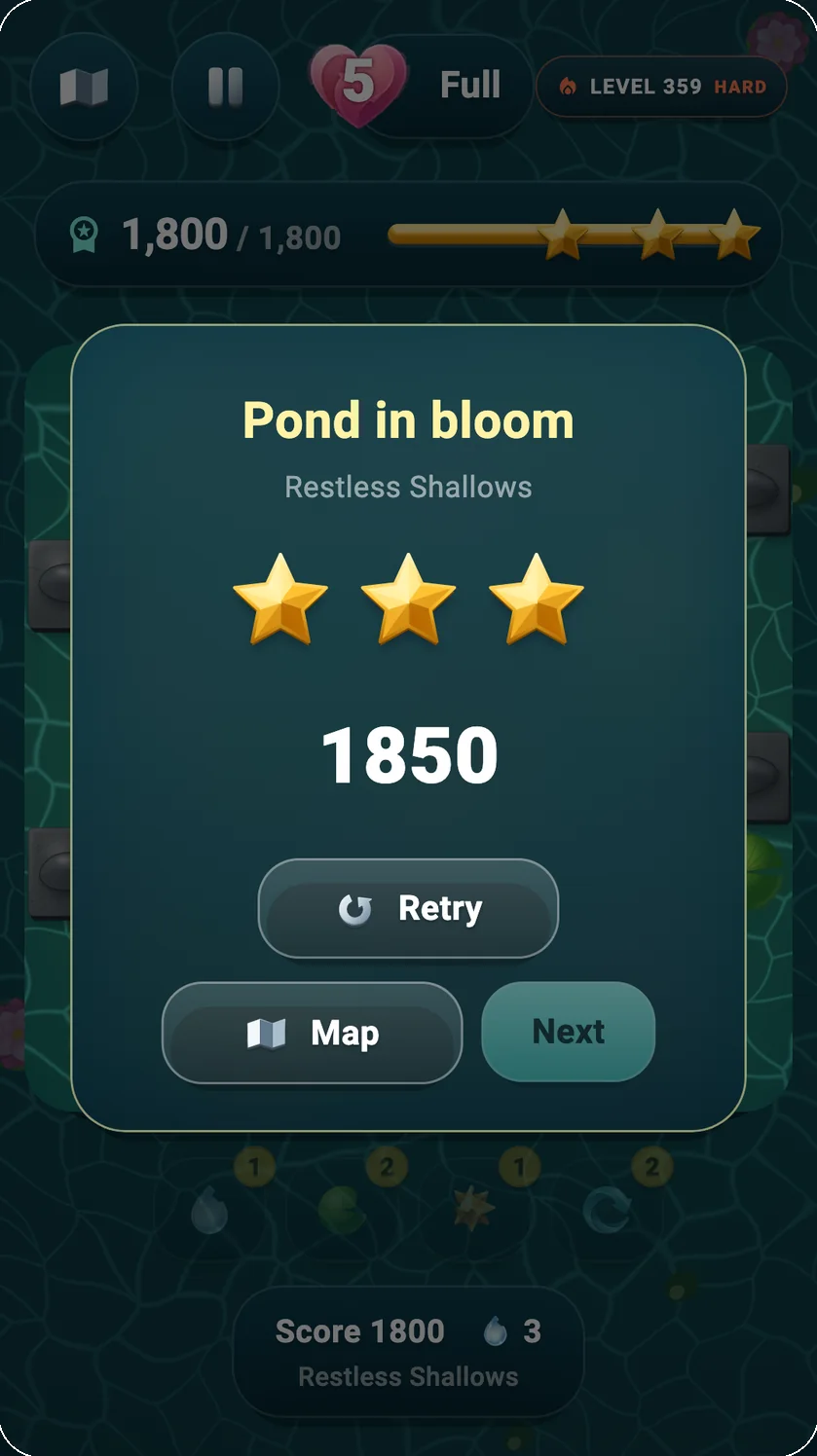
What the art direction is actually for
None of this means the palette and the score do not matter. They matter enormously — but as amplifiers, not as the mechanism. Soft light on moving water makes a calm ruleset feel calm. Put the same art on a game with a thirty-second timer and you get something worse than an honestly fast game: you get a game that lies about what it is.
The test we kept coming back to is simple. Open the game, look at a board, put the phone face down, and go and do something else for ten minutes. If you come back and nothing has been taken from you, the game is relaxing. If you come back to a lost streak or an expired multiplier, it is not, whatever it looks like.
That is the standard Kinetic Lotus is built to meet. You can read how the ripple system works in the gameplay guide, or start with the tips page if you already have it installed and want the third star.